Solar pumping at constant pressure:
sprinkler, gun and centre pivot
A sprinkler line, a gun or a centre pivot require a steady flow and a steady pressure for the whole duration of the watering turn. LE LAB sizes the operating point, the pump, the photovoltaic array and the backup source needed when solar power becomes insufficient.
A flow, at a pressure, for a given time
In pumping at the pace of the sun, the order concerns a quantity: so many cubic metres a day, lifted when the solar resource allows and kept in a pond. Sprinkling sets a different equation. The device has a service pressure and a nominal flow, and it waters correctly only at that pair. Sixty cubic metres spread over a six-hour watering turn therefore read as follows: ten cubic metres per hour to be held continuously, at three bar at the delivery point. The aim of the calculation is no longer the quantity recorded in the evening, but holding the operating point for the whole window.
The pressure required by the watering equipment converts into a head of water and adds to what the pump must already overcome: the depth of abstraction, the elevation up to the plot and the friction losses in the pipe. One bar is equivalent to 10.2 metres of fresh water column. A setpoint of 3.0 bar therefore weighs 30.6 metres, as much as an extra thirty-metre borehole.
The flow to be held also governs the pipe. A diameter chosen for slowly filling a pond becomes narrow as soon as the same volume passes in a few hours: velocity rises, friction with it, and every metre lost ends up in the head the pump has to deliver. The pipeline is therefore sized on the regulated flow, not on a daily average.
A setpoint held by regulation and a backup source
A pressure sensor is fitted at the pipe outlet, after the filter, as close as possible to the delivery point. The controller reads this measurement and adapts the pump speed. This loop limits the effect of solar power variations on the pressure delivered to the watering network.
As long as the photovoltaic array supplies the necessary power, pumping runs on solar. When that power falls, the grid or a generator brings the complement through the alternating-current input provided by the chosen architecture. The controller then keeps the pressure and flow setpoint defined for the project.
Two families carry this alternating-current input: the PSk3 builds it into its controller, while the PSk2 receives it from a separate cabinet, the smartPSUk2. LE LAB sizes constant pressure on both families; the detail of the two architectures is set out on the LORENTZ PSk hybrid page.
Starting the generator can be entrusted to the system itself: the smartStart closes a volt-free contact as soon as the backup source is called and launches the machine through its two-wire remote start function, with no operation out in the plot.
The solar and generator page details the choice and the requirements of the backup source. The LORENTZ PSk hybrid page presents the architecture of the controllers, the smartPSUk2 and the smartStart.
Sixty cubic metres a day in Granada, at 3.0 bar
A 1.2 hectare market garden plot in Andalusia, watered by sprinkling. Peak demand reaches 60 m³ a day, the window lasts six hours and the pressure required at the delivery point is 3.0 bar. The water comes from a 55 metre borehole, the watering head sits 5 metres above it, and thirty metres of pipe separate the two. Here is the study as the application renders it.
| Input data | Value | What it becomes in the calculation |
|---|---|---|
| Daily need | 60 m³/day | with six hours of watering: 10 m³/h to be held continuously |
| Pressure at the delivery point | 3.0 bar | 30.6 m added to the total dynamic head |
| Pumping depth | 55 m | the fixed part of the head |
| Delivery height | 5 m | the elevation up to the delivery point |
| Pipe | 30 m | 63 mm outside diameter in PN 16, velocity of 1.33 m/s at the regulated flow |
| Head losses | 5.4 m | 3.4 m from friction, 2 m at bends and valves, that is 6% of the total |
| Total dynamic head | 96 m | the head to be delivered at 10 m³/h, continuously |
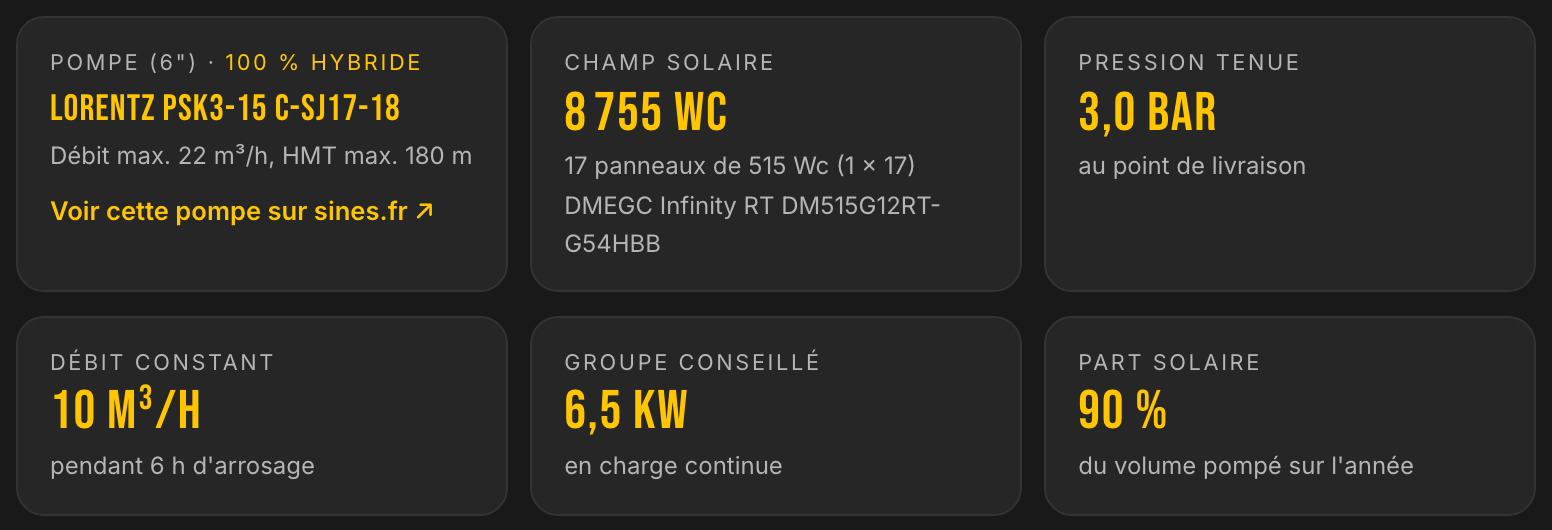
The six values that sum up the study, as they appear in the application.
The selected solution is a LORENTZ PSk3-15 submersible pump paired with C-SJ17-18 hydraulics, capable of 22 m³/h and 180 metres at the top of its range. At 10 m³/h against 96 metres, it draws 4.3 kW at the motor. The array counts 17 modules of 515 Wp in a single string, that is 8,755 Wp, tilted at 34 degrees. The generator recommended for the backup source reaches 6.5 kW at continuous load. It follows from the manufacturer's rule, which multiplies by 1.5 the power drawn at the operating point: the 4.26 kW drawn give 6.39 kW, rounded up to the next half kilowatt. The sizing is detailed on the page devoted to the generator supporting solar pumping.
Solar and backup share, month by month
The calculation confronts the watering window with sixteen years of real solar resource, hour by hour. The power demanded stays constant during the window, while photovoltaic output varies. The backup source supplies the gap needed to hold the flow and the pressure; the split between the two sources changes with the hour and the season.

The monthly volume and its split between the two sources.
| Month | Volume pumped | Solar share | Backup share |
|---|---|---|---|
| January | 1,860 m³ | 83% | 17% |
| February | 1,680 m³ | 83% | 17% |
| March | 1,860 m³ | 85% | 15% |
| April | 1,800 m³ | 87% | 13% |
| May | 1,860 m³ | 91% | 9% |
| June | 1,800 m³ | 97% | 3% |
| July | 1,860 m³ | 99% | 1% |
| August | 1,860 m³ | 98% | 2% |
| September | 1,800 m³ | 94% | 6% |
| October | 1,860 m³ | 90% | 10% |
| November | 1,800 m³ | 83% | 17% |
| December | 1,860 m³ | 85% | 15% |
Over the year, 90% of the volume pumped comes from the sun and 10% from the backup source, concentrated from November to April. Translated into energy, that represents about 965 kWh a year to be supplied by the second source, and close to 570 hours of running. The contrast between July, where the backup source weighs 1%, and the winter months, where it rises to 17%, comes down to two causes pulling the same way: the day is shorter and the irradiation lower.
A typical day in November
The photovoltaic array is sized on the least sunny month of the pumping season. In Granada, with watering all year round, that is November. The typical day of this month shows where the effort of the complement falls, hour by hour over the six hours of the window.
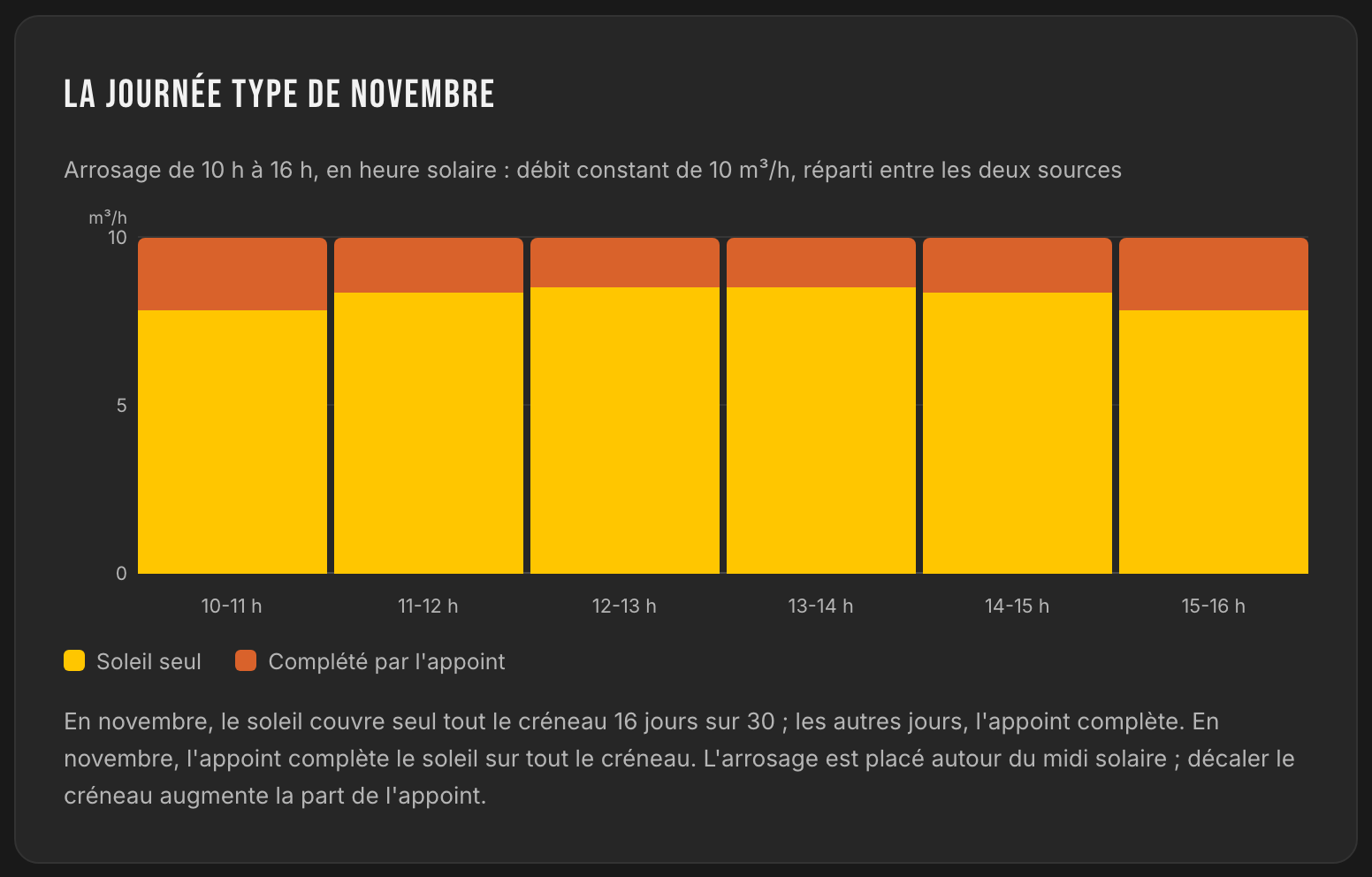
All the bars have the same height: the flow is constant, only the split changes.
The window runs from 10:00 to 16:00 in solar time. The sun holds 79% of the flow in the first and the last hour, 86% around solar noon; the backup source does the rest. These values are monthly averages: in the detail of the days, the sun alone covers the whole window on sixteen days out of thirty, and on the other days the second source tops it up.
| Solar time | Flow held | Average solar share |
|---|---|---|
| 10:00 to 11:00 | 10 m³/h | 79% |
| 11:00 to 12:00 | 10 m³/h | 84% |
| 12:00 to 13:00 | 10 m³/h | 86% |
| 13:00 to 14:00 | 10 m³/h | 86% |
| 14:00 to 15:00 | 10 m³/h | 84% |
| 15:00 to 16:00 | 10 m³/h | 79% |
Limits and non-standard cases
Three observations come with the study and deserve to be set out before ordering the equipment.
Small volumes can lead to oversized equipment
Constant pressure calls for a machine able to hold the operating point for the whole declared duration. On the same site in Granada, at 20 m³ a day and six hours of watering, the smallest compatible set supplies 3.3 m³/h with an array of 5,850 Wp: a third of the volume of the main example still demands two thirds of its photovoltaic power. The application shows the available solutions and flags this on screen: below about 40 m³ a day, the operating range of the compatible pumps may start above the requested flow: the selected configuration is then sized above the need.
The window is placed around solar noon
The watering window used by the calculation is centred on the solar noon of the site, that is at the best place on the curve. A window shifted towards the morning or the evening remains technically possible, with the same components, and raises the share taken by the second source. The assumption is written under the chart and repeated in the report, so that the figure stated refers to a known schedule.
Drip irrigation follows another logic
Localised irrigation works at low pressure and accepts a variable flow: it fills a pond or irrigates at the pace of the resource, and remains the least energy-hungry mode. The sizing path stays the same for it, with a monthly output and a reserve autonomy. The watering device declared at step 3 therefore governs the whole calculation downstream.
Constant pressure in LE LAB
At step 3, the application asks for the type of watering device. Choosing a sprinkler, a gun or a centre pivot brings up the daily duration and the pressure required at the delivery point; the flow to be held is then calculated and shown alongside the daily need.
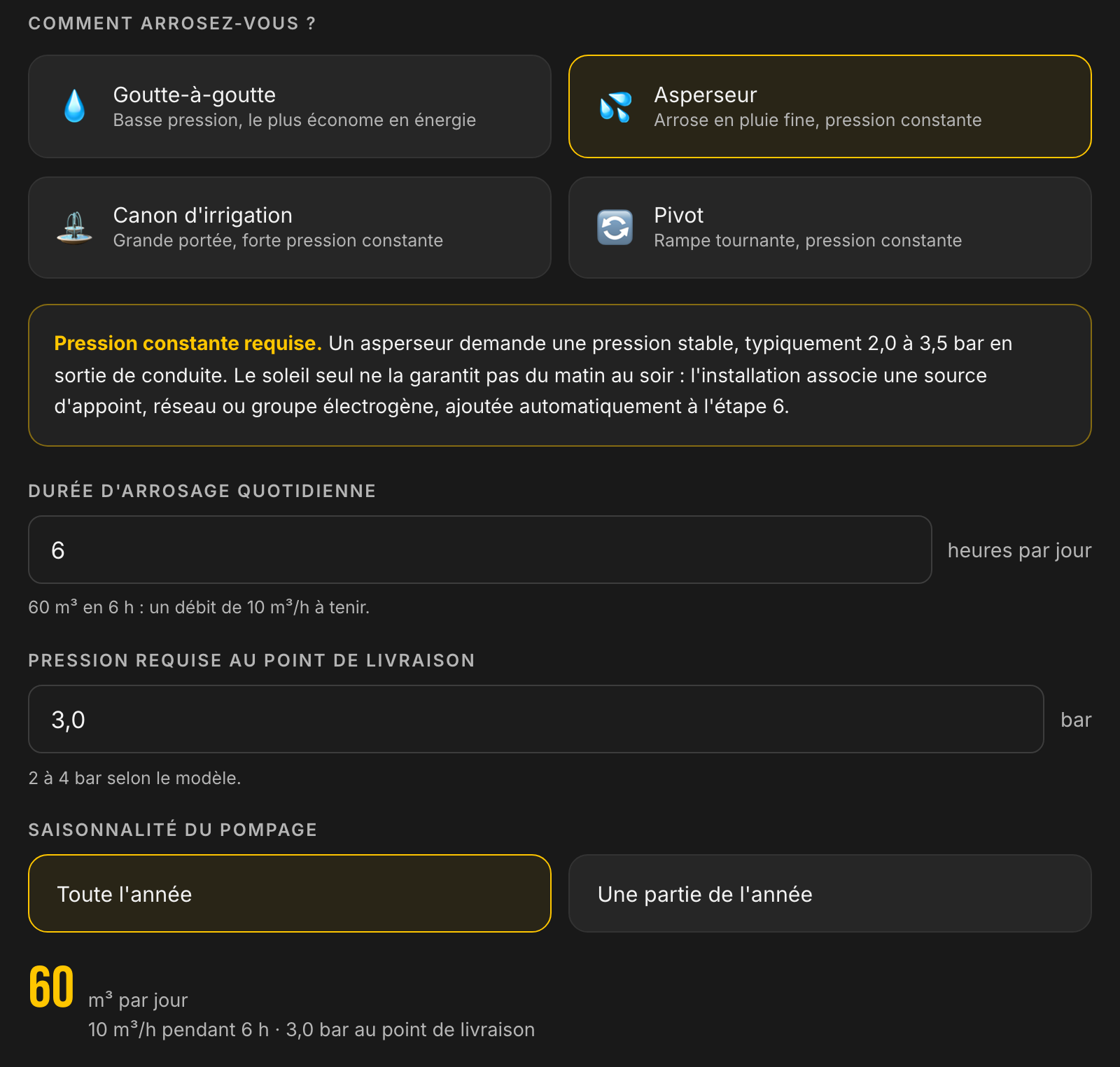
Step 3 with a sprinkler selected: the duration, the pressure and the flow that follows.
The daily duration is entered between one and sixteen hours. The pressure is prefilled according to the device and remains editable from 0.5 to 10 bar: 3.0 bar for a sprinkler, 5.5 bar for an irrigation gun and 2.5 bar for a centre pivot, with the usual range recalled under the field. The screen presents together the daily volume, the regulated flow and the setpoint at the delivery point.
At step 6, the backup source is ticked automatically and stays so as long as the pressurised device is selected, with the reason written on the card. The results then replace the usual monthly output with the two blocks seen above, the month-by-month split and the typical day of the design month. The professional report adds a dedicated section: the setpoint with its minimum and maximum at half a bar, the position of the sensor, the flow to be held with its window, then the recommended generator, the annual solar share, the energy and the running time demanded of the second source.
Variable-speed sets supplied with direct current answer other needs, in particular high flows on deep boreholes: the page devoted to SPE and RSI sets details their sizing logic.
Where these figures come from
- Application note “Hybrid Irrigation in Spain”, LORENTZ: design of a system at constant flow and constant pressure with a backup source, position of the pressure sensor after the filter, sizing of the generator from the motor power multiplied by 1.5.
- Application note “Automatic flow control”, LORENTZ: holding a setpoint by speed regulation, calling the alternating source only when it is needed, start delay set at commissioning.
- Application note “PSk2, smartPSUk2 hybrid system layout and design”, LORENTZ: switching and blending of the two sources, specifications of the accepted generators, volt-free contact of the smartStart and two-wire remote start function.
- PSk3 controller manual, LORENTZ: built-in alternating-current input, combination of the two energy sources, non-sinusoidal input current of the rectifier, installation of the pressure sensor.
- Flow-head curves and power curves from the LORENTZ product data sheets for the hydraulics cited as an example.
- Hourly irradiation data for the site, sixteen years of history for Granada, and the official data sheet of the selected photovoltaic module for its temperature coefficients.
Figures taken from the manufacturers' official documentation, versions in force at the date of publication; the manual remains the reference. A page published by SINES.