Water reserve and
coverage of the need
Pumping follows the solar resource. The reserve stores the water produced and makes it possible to carry part of that production over to the less favourable days.
What the block measures
LE LAB simulates the production and the reserve level day by day over the weather history available for the site. The results describe that history and the configuration studied; they are not a guarantee for the years to come.
The choice at step 6 determines the result
An existing reserve is entered
Ticking “I already have a water reserve” and entering its volume. The block assesses this capacity in the configuration studied.
| Main indicator | Average number of days covered over a year. |
|---|---|
| Warning | Flags coverage insufficient for the criteria of the block. |
| Unfavourable episode | Historical period during which the level of service is the most constrained. |

The reserve has to be sized PRO
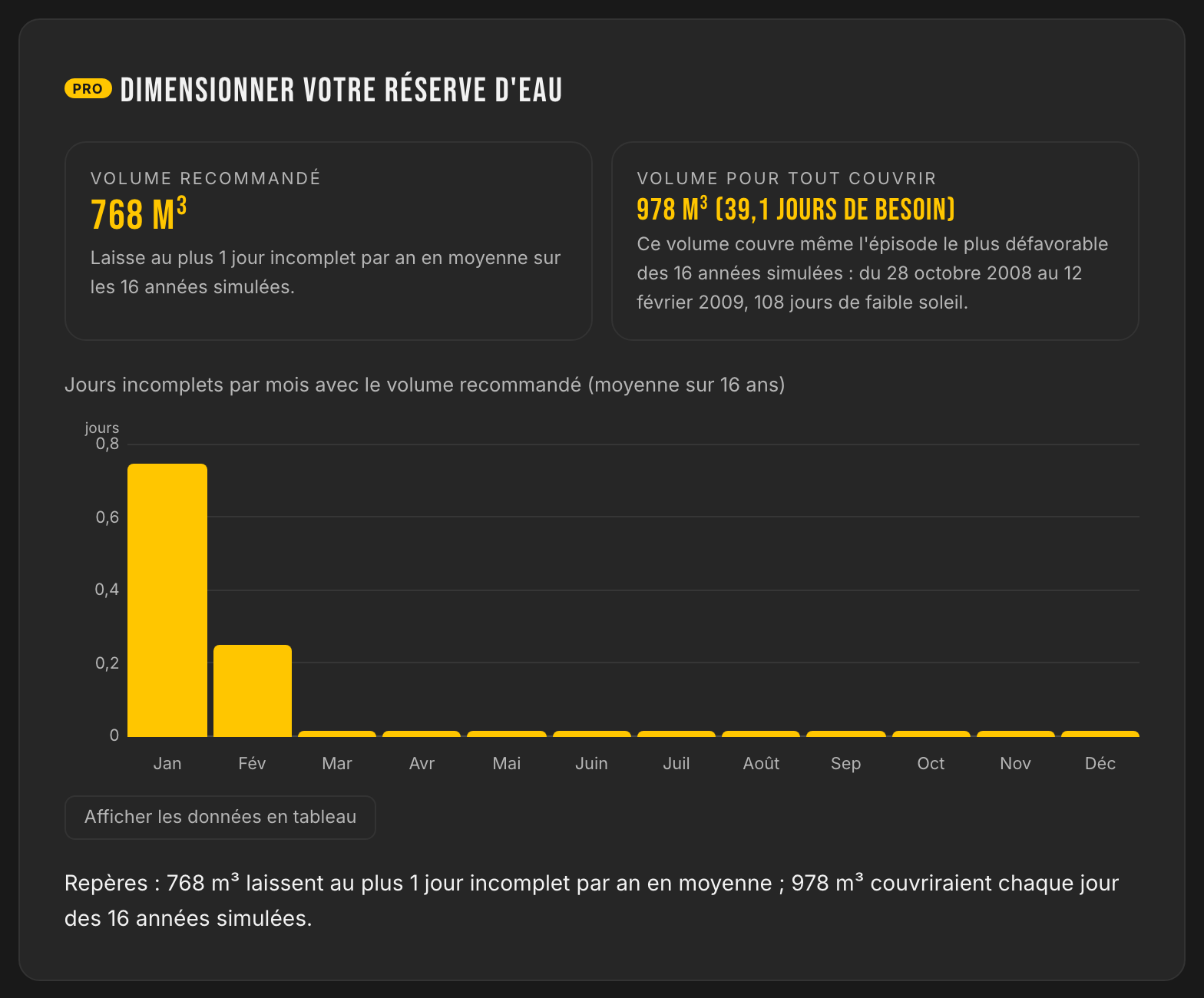
Ticking “help me size it”. The result block is then titled “Size your water reserve” and offers two reference points:
- Recommended volume: coverage target defined by the application on the simulated history.
- Volume to cover everything: capacity that covers every day of the history studied.
These two volumes are sizing reference points. The final choice depends on the use, the space, the civil works, the water quality and the level of service sought.
No reserve is declared
The result block is titled “Coverage of the need”. It presents the coverage obtained at the pace of the sun, without water storage, states the number of days fully covered and shows the indicative effect of larger solar arrays. Its summary sentence states the number of days that “fall below 20 %” of the need.
This reading makes it possible to determine whether a reserve should be studied. It does not mean that a reserve volume has already been chosen.

Reading the incomplete days per month
Each bar represents the average number of incomplete days in the month. The decimals come from the average over several years: they do not describe a precise fraction of a day to come.
The associated table gives the figures. An identical annual total can hide two different situations: a few isolated days or one concentrated unfavourable period.

Checks before settling on a volume
- The daily need and its seasonality are confirmed.
- The usable volume is distinguished from the geometric volume of the structure.
- Losses, additional uses and external inflows are examined.
- The material, the water quality and the sanitary conditions are compatible.
- The result is presented as a historical simulation, not as a guarantee.