Constant-pressure
watering
Sprinkler, irrigation gun and centre pivot: understanding the specific fields, the backup power and the reading of the result.
Principle
A constant-pressure device requires a flow, a pressure and a watering time to be held at the same time. The solar source varies over the day; a backup source is therefore paired automatically.
The path starts at step 3, in the block “How do you irrigate?”, with the card “Sprinkler”, “Irrigation gun” or “Centre pivot”. Drip irrigation does not open this path.
Entry at step 3
After the sprinkler, the gun or the centre pivot is selected, two fields appear: daily duration and pressure at the delivery point. The flow to be held is displayed from the volume and the duration.

Backup source required at step 6
The backup card is ticked automatically and cannot be removed as long as a constant-pressure device is selected. The reserve to be sized is not offered on this path.

Specific result
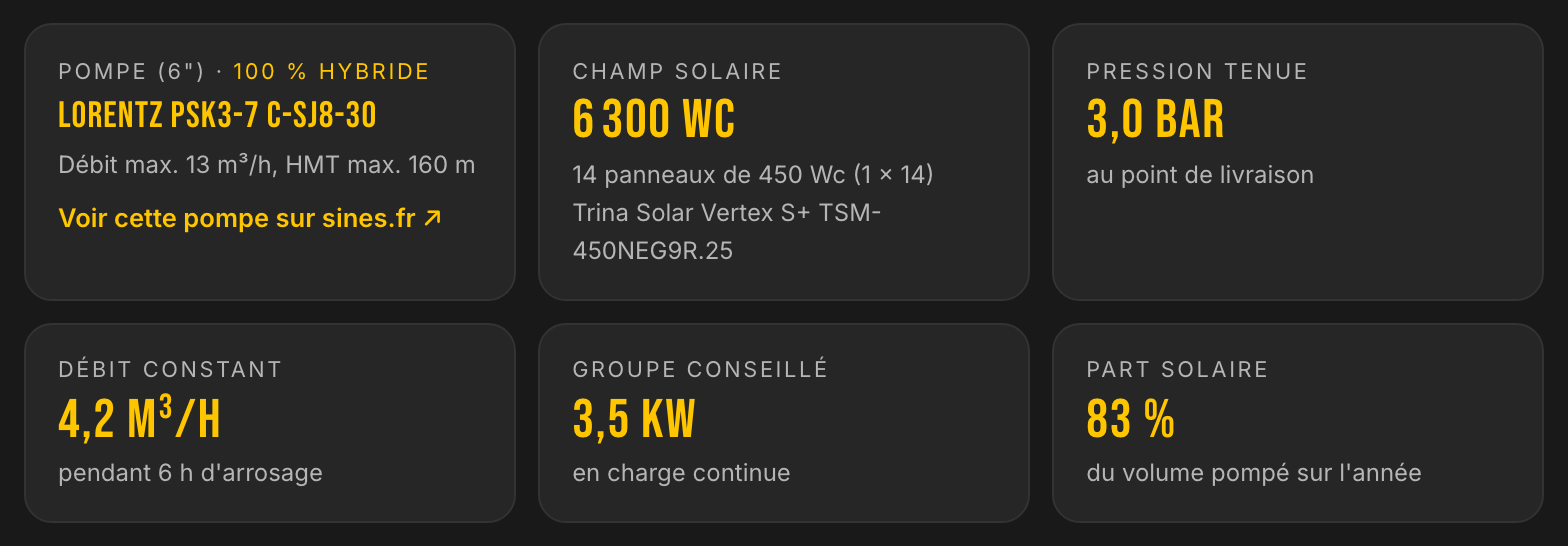
The summary adds the pressure held, the constant flow, the recommended generator power and the solar share. The monthly chart separates the solar contribution from that of the backup source.
Solar and backup split
The monthly bars distinguish the volume supplied by each source. This reading must be compared with the assumptions of use and with the real availability of the backup source.

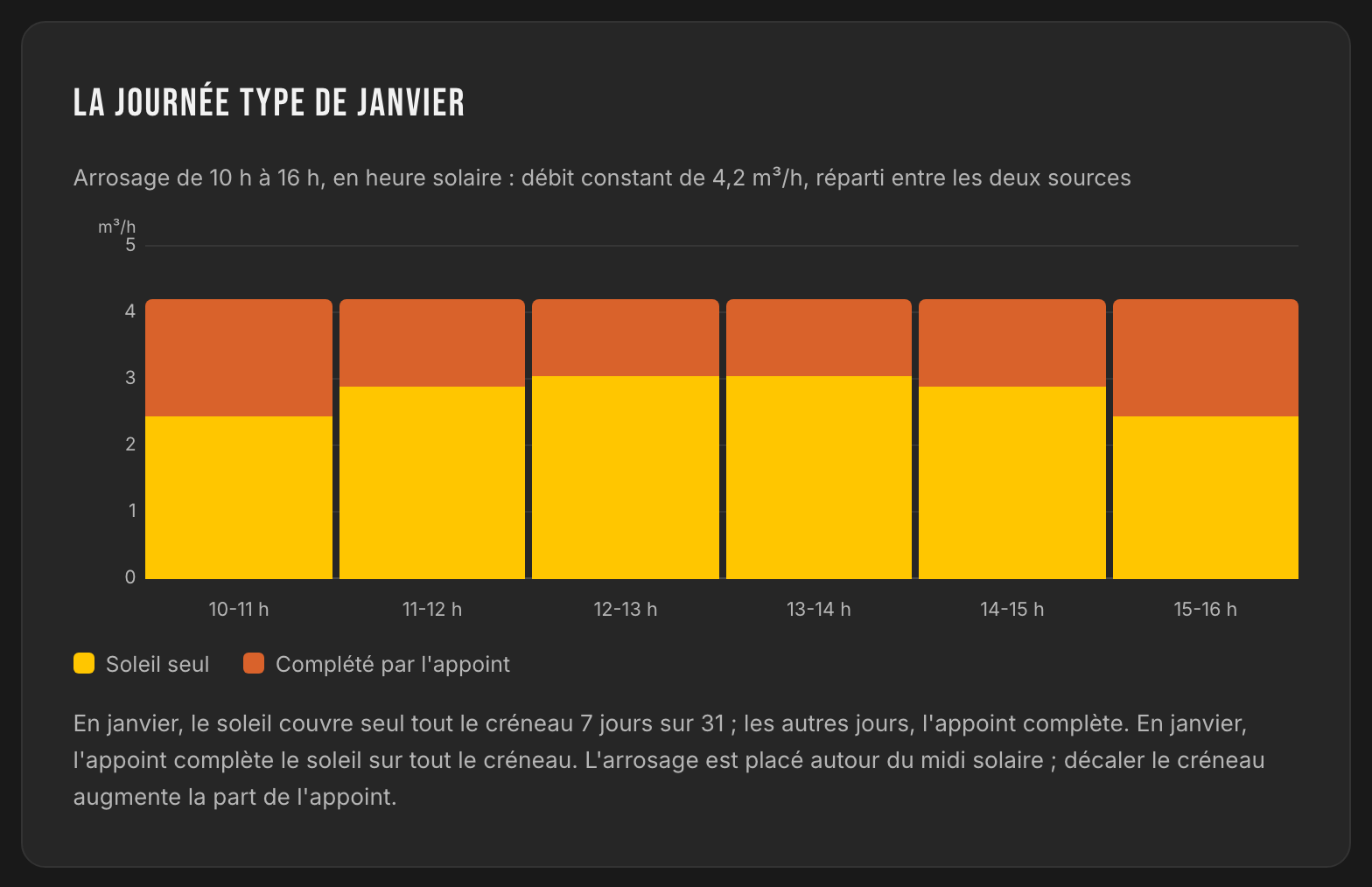
A typical day in {mois}
The block carries the design month, the least sunny of the watering season: there is therefore no month selector, unlike the daily output of the other paths. The subtitle recalls the window and the flow: “Watering from {h1} to {h2}, solar time: a constant flow of {q} m³/h, split between the two sources”.
The hourly bars are all at the same height, the flow held. What changes from one hour to the next is the share the sun covers. The day drawn is a real average day, computed on the hourly data of the site history, and not a smoothed curve: the summary sentence indeed opens with a count of days, the number of days in the month when the sun held the whole window on its own.
Watering window PRO
The setting moves the watering window relative to solar noon and recalculates the split between the sources.

What the result no longer contains
The blocks “Estimated monthly output” and “Daily output” give way to the two charts above. The block “Autonomy and water reserve” also disappears: the backup source holds the flow at all times, the question of the number of days served without sun no longer applies and the reserve is no longer part of the circuit.
The installation diagram stays on display. It shows the watering device, the pressure at the delivery point and the backup line with the recommended generator power.

In the study report
The PDF report gains a section “Pression constante et source d'appoint”, in two parts.
| Setpoint | Pressure setpoint with its minimum and maximum limits, position of the pressure sensor, constant flow to be held and watering window. |
|---|---|
| Backup source | Generator recommended at continuous load, automatic starting and stopping for the families concerned, solar share over the year, energy supplied by the backup source, generator running time and estimated diesel with its assumption. |
Points to check
- Watering time and pressure required.
- Availability and characteristics of the backup source.
- Generator power stated in the result.
- Solar share month by month.
- Position of the watering window.
- Warning messages or absence of a standard solution.